
Showing posts with label Spot Diagnosis. Show all posts
Showing posts with label Spot Diagnosis. Show all posts


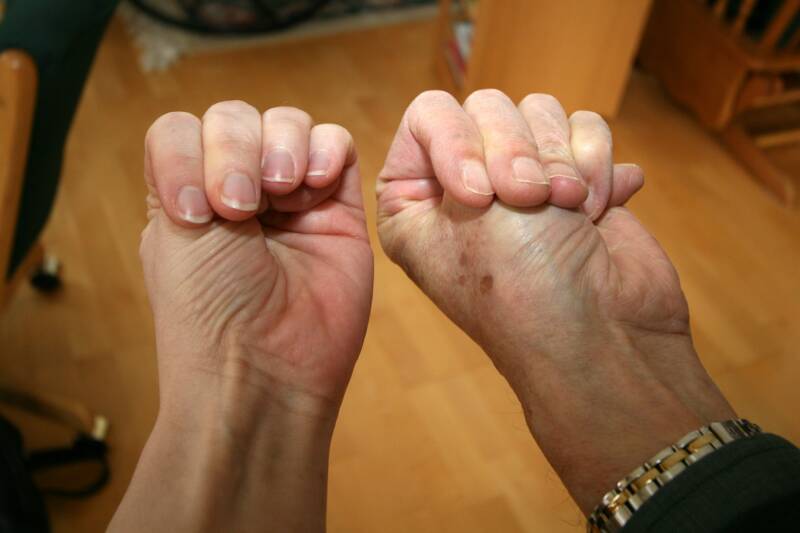

What is your answer!

This young boy suffers from:
A) Hutchinson triad
B) Foeser-Kennedey syndrome
C) Marcus Gunn pupil
D) Marcus Gunn phenomenon
E) Argyll-Robertson pupil
What is the diagnose?
M.D. is a 35-year-old Malay labourer who presented
 BP136/85 mmHg, PR 98/min regular, non-collapsing
with progressive shortness of breath on exertion 3/12.
There was no history of chest pain, palpitation, or
swelling of the legs. He sleeps with two pillows.
There was no history of acute rheumatic fever. He denies using illicit drugs. He was diagnosed to have a“murmur” in the heart in childhood.
Physical examination:
Afebrile
Orthopnea
Tachypnea
Polycythaemia
JVP: elevated
Heart: Apex beat 6th ICS 3 cm lateral to MCL,
forceful
No L parasterne
Loud split 2nd HS
EDM 1/6 in L sternal edge
EDM 1/6 in L sternal edge
Chest: NAD
Abdomen: Liver 2fb
CNS: NAD
What is your diagnosis?


Lingua Scrotalis

When grooves develop in the tongue, the condition is called scrotal tongue. It makes the tongue look wrinkled. Scrotal tongue has other names, too. It also is called furrowed tongue, lingua fissurata, lingua plicata, lingua scrotalis, plicated tongue or grooved tongue.
The tongue can have many grooves or a single groove down the middle with others branching off from it. Scrotal tongue affects 2% to 5% of the population of the United States. Rates in other countries vary. However, one study reported that the condition is found in up to 21% of people worldwide.
People usually are born with this condition, but may not notice it right away. It gets more noticeable as you age.
Sometimes, scrotal tongue occurs as a result of infection or poor nutrition. It also is seen in people with certain health conditions. These include:
- Melkersson-Rosenthal syndrome — This neurological disorder also includes facial nerve palsy and swelling of the face, especially the lips.
- Down syndrome
- Benign migratory glossitis, or geographic tongue — People with this condition have patches of smooth or bald tongue along with rougher areas where the taste buds are normal.
Symptoms
Scrotal tongue is a harmless condition. It usually has no symptoms. Sometimes, if the grooves are deep enough, you may get a burning sensation when you eat certain spicy or acidic foods. This is fairly rare, however. If the grooves are deep enough, they may harbor colonies of bacteria or bits of food. This can lead to bad breath or fungal infections of the tongue.
Diagnosis
Generally, people don't even know they have scrotal tongue until their dentist tells them. Your dentist or physician can diagnose this condition by looking at your tongue.
Expected Duration
Scrotal tongue is a lifelong condition.
Prevention
There is no way to prevent scrotal tongue.
Treatment
There is no treatment for scrotal tongue. If your tongue burns when you eat, you should avoid the foods that bother you. This should include cleaning your tongue daily with your toothbrush or a tongue scraper. You can buy these in drugstores.
When To Call A Professional
Check with your dentist if the grooves become uncomfortable.
Prognosis
Scrotal tongue is a lifelong condition, but it usually does not cause discomfort or problems.

Spot diagnosis

ANSWER
Cornu Cutaneum
A cutaneous horn (Cornu Cutaneum) is a relatively rare tumour, most often arising on sun-exposed skin in elderly men, usually after the Vth decade. The tumor is often conical, consisting of marked retention of stratum corneum. This lesion can be caused by many primary underlying processes that may be benign, premalignant or malignant, thus the importance of accurate determination of the nature of the conditions at the base of the lesion. Surgery is the treatment of choice. We describe an illustrative case with cutaneous horn of the forearm. We also review various known causes of cutaneous horn and the pertinent literature.


Spot diagnosis

ANSWER
Dermatitis herpetiformis
Dermatitis herpetiformis (DH) is an autoimmune blistering disorder associated with a gluten-sensitive enteropathy (GSE). Dermatitis herpetiformis is characterized by grouped excoriations; erythematous, urticarial plaques; and papules with vesicles. The classic location for dermatitis herpetiformis lesions is on the extensor surfaces of the elbows, knees, buttocks, and back. Dermatitis herpetiformis is exquisitely pruritic, and the vesicles are often excoriated to erosions by the time of physical examination.
Pathophysiology
Dermatitis herpetiformis is a disease of the skin caused by the deposition of IgA in the papillary dermis, which triggers an immunologic cascade, resulting in neutrophil recruitment and complement activation. Dermatitis herpetiformis is the result of an immunologic response to chronic stimulation of the gut mucosa by dietary gluten.
Pathophysiology
Dermatitis herpetiformis is a disease of the skin caused by the deposition of IgA in the papillary dermis, which triggers an immunologic cascade, resulting in neutrophil recruitment and complement activation. Dermatitis herpetiformis is the result of an immunologic response to chronic stimulation of the gut mucosa by dietary gluten.

What is diagnosis?

nausea, vomiting, and increasingly severe abdominal pain that radiates to his left shoulder and back.
He appears extremely dehydrated and is short of breath. His temperature is 37.8°C (100°F), pulse is 120/min,
respirations are 18/min, and blood pressure is 80/60 mm Hg. Abdominal examination shows distention with
epigastric tenderness. Bowel sounds are decreased. Rectal examination shows no abnormalities. Test of the
stool for occult blood is negative. Laboratory studies show:
Hemoglobin 5.5 g/dL
Leukocyte count 15,500/mm3
Serum
Ca2+ 7.5 mg/dL
Amylase 750 U/L
A CT scan of the abdomen is shown.
Subscribe to:
Posts (Atom)
About


LinkWithin
